
Fetching financial insights...
•
•
•
•
•
•
Should you take a personal loan to clear credit card debt in India? Compare costs, see an EMI example, and check alternatives before you apply.
Grofi Editorial
Senior Financial Analyst
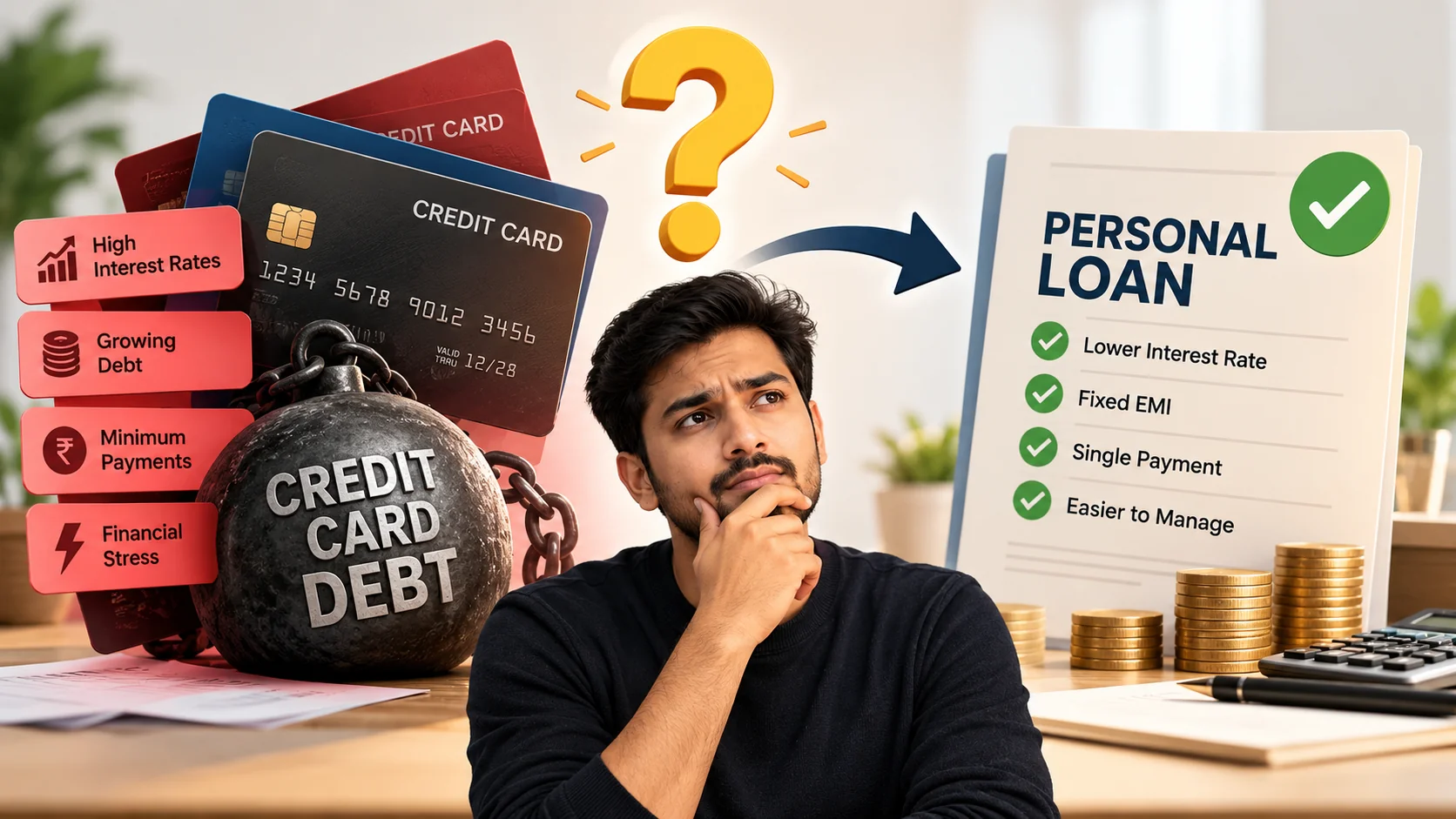
Credit cards make everyday payments convenient, but unpaid balances can become expensive surprisingly quickly. If you are struggling to clear your outstanding dues, you may be considering a personal loan to pay off your credit card debt.
At first, the idea sounds simple: borrow money at a potentially lower interest rate, repay your credit card balance, and then pay back the personal loan through fixed monthly instalments.
But is this actually a smart financial decision?
A personal loan can help you manage credit card debt if its total repayment cost is lower, the EMI fits your budget, and you avoid accumulating new card debt. However, it is not the right solution for everyone.
In this guide, we explain how debt consolidation works, compare the costs, explore alternatives, and help you understand what to check before applying for a personal loan in India. If you want to compare options as you read, you can explore personal loans on Grofi.
Credit cards often provide an interest-free period when you pay the full statement balance by the due date and meet the card's terms. However, carrying an unpaid balance can lead to finance charges and the loss of the interest-free benefit, subject to the issuer's terms.
Many credit cards charge significantly higher interest rates than personal loans. The exact rate depends on the card issuer and the terms of your card agreement.
For example, if you repeatedly pay only the minimum amount due, most of your remaining balance can continue attracting interest. Your repayment may stretch over months or years, increasing the total amount you pay.

Thinking of a gold loan in India? Learn the RBI's LTV limits, bullet-repayment cap, auction rules and the risks to weigh before pledging jewellery.
Grofi Editorial
Senior Financial Analyst
The Reserve Bank of India requires card issuers to prominently warn customers in their billing statements that paying only the minimum amount can stretch repayment over months or years with compounded interest. You can read this in the RBI's amendment to the credit card and debit card directions.
If you cannot pay the full bill, it is worth exploring repayment options before the debt grows further.
Debt consolidation means combining existing debts into a new loan or repayment arrangement.
Suppose you have outstanding balances on two credit cards. Instead of managing both balances separately, you apply for a personal loan and use the approved amount to repay those cards.
You then repay the personal loan through scheduled EMIs over an agreed tenure.
The objective is to simplify repayment and, where possible, reduce the total cost of borrowing.
However, approval is not guaranteed. Lenders assess factors such as income, existing obligations, repayment history, credit profile and their own eligibility criteria. If you are unsure how much you could borrow, our guide on how much personal loan you can get on a ₹25,000 salary explains how lenders look at income and existing EMIs.
The most important question is not whether the personal loan has a lower advertised interest rate. It is whether the complete loan arrangement costs less than your current repayment option.
Compare these factors before deciding:
Swipe table to view more →
Always compare the annualised borrowing cost, fees, tenure and total amount payable. A lower EMI does not automatically mean a cheaper loan. You can test different amounts, rates and tenures with the Grofi EMI calculator.
Consider a hypothetical example in which you have ₹1,00,000 in credit card debt.
Assume the following illustrative offers:
These figures are for illustration only, not current market quotations or guaranteed offers.
For a ₹1,00,000 personal loan at 18% annual interest over 12 months:
The estimated interest component is about ₹10,016.
To judge savings fairly, compare the loan with repaying the same ₹1,00,000 card balance over the same 12 months at the assumed 3% monthly rate, with no new purchases and no extra fees.
Under these assumptions, the personal loan would cost roughly ₹8,000 to ₹8,500 less, even after the processing fee. The gap comes from the interest rate difference, and it shrinks or disappears if the loan's rate or fees are higher than assumed.
If you instead paid only about ₹9,168 a month on the card, you would still owe roughly ₹12,500 after 12 months and would need around 14 months to clear the debt.
Real outcomes depend on how your issuer calculates interest, any fees or taxes, and what you pay each month. Some issuers also offer card EMI conversion at different rates, so request that quote as well and compare the total cost.
A personal loan may be worth considering if several of the following conditions apply.
Check the interest rate, processing fee, taxes, insurance add-ons if any, and prepayment charges. Compare the total amount payable rather than the headline rate alone.
Your EMI should leave enough money for essential expenses, other debt repayments and unexpected costs. Avoid accepting a repayment obligation that is affordable only in an unusually good month.
A fixed tenure can help you work towards becoming debt-free. Choose a repayment period that balances an affordable EMI with a reasonable total interest cost.
Once the old balance is cleared, avoid treating the available credit limit as extra income. If you continue spending beyond your budget, you could end up with both a personal loan and new credit card debt.
Read the lender's terms, including the annual percentage rate where disclosed, late-payment charges, foreclosure rules, and any optional or bundled products.
Consolidation may not solve the underlying problem if:
If you cannot manage the current repayments, contact your card issuer or lender to discuss the options available. Be cautious of services that promise guaranteed debt elimination or demand upfront fees without clear, verifiable terms.
A personal loan is not the only option for managing credit card debt. A balance transfer may allow eligible customers to move an outstanding balance to another card with a promotional or lower interest rate.
However, balance transfers can have fees, promotional periods and conditions. The rate may rise after the promotional period ends, and eligibility depends on the issuer.
Compare the options carefully:
You can also ask your card issuer about converting eligible outstanding dues into EMIs. Compare the effective cost and conditions of that option with a personal loan.
It can affect your credit profile in several ways, although the outcome depends on your circumstances and the lender's reporting.
A new loan application: Applying for credit may result in a lender enquiry on your credit report. Multiple applications over a short period may not be helpful.
Your outstanding card balance: Paying off a large credit card balance may reduce your credit utilisation, which can be beneficial for your credit profile.
Your new loan: The personal loan becomes another credit obligation and may affect how lenders assess your existing debt and repayment capacity.
Your payment history: Paying EMIs on time helps build a positive repayment record. Missed or late payments can harm your credit profile.
There is no guaranteed increase in your CIBIL score simply because you take a personal loan. Focus on timely payments, responsible borrowing and keeping your total debt manageable.
Before using a personal loan to repay credit card debt, follow this checklist:
3.Calculate the total cost. Add all EMIs and upfront costs, then compare the result with alternative repayment strategies using the Grofi EMI calculator.
It can be, but not always. Compare the effective borrowing cost, fees, tenure and total repayment amount. Your actual savings depend on the card terms and the repayment schedule you would otherwise follow.
Yes, if the lender approves a sufficient loan amount and permits you to use it for that purpose. Check eligibility, costs and whether the loan can cover the outstanding balances in full.
It may help if your credit card utilisation falls and you maintain timely repayments. However, the new loan also creates an additional obligation, so a score improvement is not guaranteed.
Not necessarily. Consider the card's fees, benefits, your spending habits and your overall credit profile. If keeping it open encourages unnecessary spending, limiting use or closing it may be worth considering. Check the issuer's closure process and settle all outstanding dues first.
Avoid taking on new debt without a realistic repayment plan. Contact the card issuer or lender promptly, explain your situation, and ask about available repayment arrangements. Consider seeking independent financial counselling if you need help assessing your options.
It depends on the interest rate, fees, promotional period, repayment capacity and total cost. Compare both options using the same outstanding balance and a realistic repayment timeline.
Before applying, confirm that the loan offers a genuine cost advantage, that the EMI is affordable, and that you can avoid building up fresh credit card balances.
Remember: the goal is not simply to replace one type of debt with another. The goal is to repay what you owe at a manageable cost and regain control of your finances.
At Grofi, we believe better financial decisions begin with understanding your options. Compare loan options, calculate your repayment costs with the EMI calculator, and choose a strategy that fits your budget.
Disclaimer: This article is for educational purposes only and is not personalised financial advice. Loan eligibility, interest rates, fees and credit outcomes vary by lender and borrower. Verify the current terms before making a financial decision.

The RBI has proposed restricting revolving credit offered by most NBFCs. Learn how flexi loans work, what may change, and what borrowers should check.
Grofi Editorial
Senior Financial Analyst